
Private Limited Company Registration in India: Complete Guide to Company Incorporation, Benefits, Compliance & Costs
Learn everything about Private Limited Company Registration in India, including eligibility, documents, registration process, benefits, compliance requirements, costs, and tax advantages.
BUSINESS REGISTRATION
Corporating Dreams
6/14/20264 min read
Introduction
Starting a business is an exciting journey, but choosing the right legal structure is one of the most important decisions an entrepreneur can make. Among the various business structures available in India, the Private Limited Company (Pvt Ltd Company) is widely regarded as the preferred choice for startups, growing businesses, investors, and entrepreneurs.
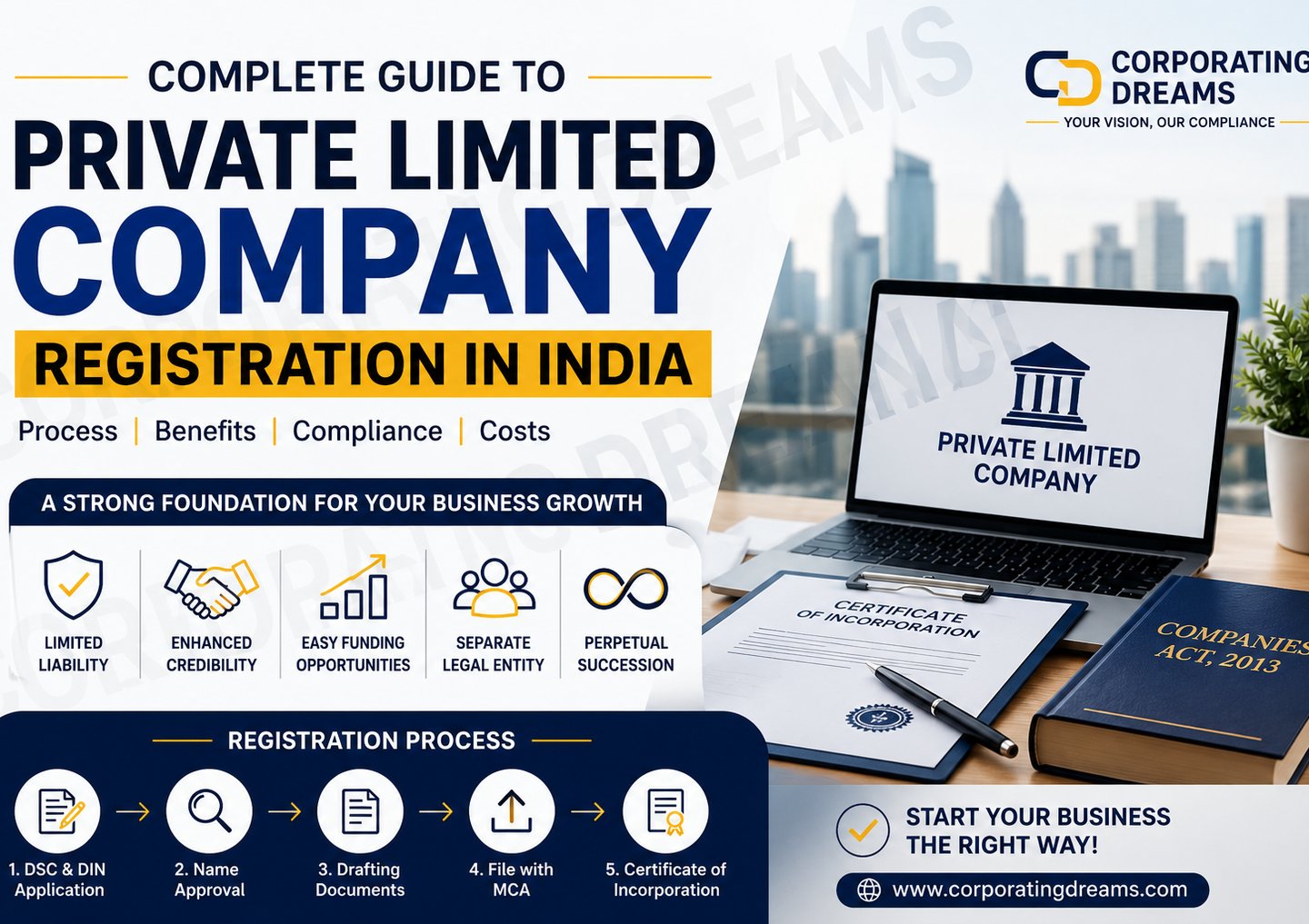
A Private Limited Company offers limited liability protection, separate legal identity, enhanced credibility, better fundraising opportunities, and perpetual succession. It is the most popular business structure among startups seeking investment, scalability, and long-term growth.
This comprehensive guide explains everything you need to know about Private Limited Company Registration in India, including eligibility, benefits, registration process, required documents, compliance obligations, and frequently asked questions.
What is a Private Limited Company?
A Private Limited Company is a privately held business entity incorporated under the Companies Act, 2013 and regulated by the Ministry of Corporate Affairs (MCA).
A Private Limited Company has a separate legal identity from its owners, meaning the company can own assets, enter contracts, sue, and be sued in its own name.
The liability of shareholders is limited to the amount invested in the company.
Key Features of a Private Limited Company
Separate Legal Entity
The company exists independently from its shareholders and directors.
Limited Liability Protection
The personal assets of shareholders remain protected against business liabilities.
Perpetual Succession
The company continues to exist even if ownership or management changes.
Easy Transfer of Ownership
Shares can be transferred subject to applicable legal provisions.
Better Credibility
Customers, investors, banks, and government agencies generally prefer dealing with registered companies.
Benefits of Private Limited Company Registration
1. Limited Liability Protection
Shareholders are only liable to the extent of their shareholding.
Personal assets such as property, savings, and investments remain protected from business debts.
2. Enhanced Business Credibility
A registered Private Limited Company enjoys greater trust among:
Customers
Vendors
Investors
Financial Institutions
Government Authorities
Many large organizations prefer working with incorporated entities.
3. Easier Fundraising Opportunities
Private Limited Companies can attract:
Angel Investors
Venture Capital Funds
Private Equity Investors
Strategic Partners
Most investors prefer investing in Private Limited Companies due to their structured governance framework.
4. Separate Legal Identity
The company can:
Own property
Open bank accounts
Enter into agreements
Raise funds
Conduct business independently
5. Perpetual Existence
The company's existence is not affected by:
Death of Shareholders
Resignation of Directors
Ownership Changes
This provides long-term stability.
6. Tax Planning Opportunities
A Private Limited Company may benefit from various deductions, incentives, and business expense claims available under applicable tax laws.
Eligibility for Private Limited Company Registration
To register a Private Limited Company in India, the following requirements generally apply:
Minimum Requirements
Minimum 2 Directors
Minimum 2 Shareholders
Registered Office Address
Digital Signature Certificate (DSC)
Director Identification Number (DIN)
The directors and shareholders may be the same individuals.
Documents Required for Private Limited Company Registration
For Directors and Shareholders
PAN Card
Aadhaar Card
Passport Size Photograph
Mobile Number
Email Address
Address Proof
Registered Office Documents
Electricity Bill
Property Tax Receipt
Rent Agreement (if applicable)
No Objection Certificate (NOC)
Private Limited Company Registration Process
Step 1: Obtain Digital Signature Certificate (DSC)
Digital signatures are required for electronic filing with MCA.
Step 2: Apply for Director Identification Number (DIN)
DIN is mandatory for directors.
Step 3: Company Name Reservation
Select a unique company name and submit it for approval.
Examples:
ABC Technologies Private Limited
XYZ Solutions Private Limited
Future Growth Private Limited
The proposed name should comply with MCA naming guidelines.
Step 4: Draft Incorporation Documents
Prepare:
Memorandum of Association (MOA)
Articles of Association (AOA)
These documents define the company's objectives and internal rules.
Step 5: Filing Incorporation Application
Submit incorporation forms along with supporting documents through the MCA portal.
Step 6: Certificate of Incorporation
Upon approval, the Registrar of Companies issues:
Certificate of Incorporation
Corporate Identification Number (CIN)
The company becomes legally operational after incorporation.
What is a CIN?
CIN (Corporate Identification Number) is a unique number issued to every registered company in India.
The CIN helps identify and track company records with the Ministry of Corporate Affairs.
Post-Incorporation Requirements
After registration, companies should complete several important formalities.
Open Current Bank Account
Open a dedicated business bank account.
Maintain Proper Books of Accounts
Accurate financial records are mandatory.
GST Registration
Obtain GST registration if applicable.
Professional Tax Registration
Register where required by state laws.
MSME Registration
Eligible businesses should consider obtaining Udyam Registration.
Trademark Registration
Protect your business name and brand identity.
Annual Compliance Requirements
Private Limited Companies must comply with ongoing legal obligations.
Board Meetings
Conduct board meetings as required.
Annual General Meeting (AGM)
Hold annual shareholder meetings.
Annual Return Filing
File annual returns with the ROC.
Financial Statements
Submit audited financial statements.
Income Tax Return Filing
File company income tax returns within prescribed timelines.
Failure to comply may attract penalties and legal consequences.
Common Mistakes Entrepreneurs Make
Choosing an Incorrect Company Name
Names that violate MCA guidelines may be rejected.
Ignoring Compliance Requirements
Many new businesses overlook annual filing obligations.
Poor Documentation
Incomplete documents delay registration.
Delayed GST Registration
Businesses should assess GST requirements promptly.
Private Limited Companies are generally preferred by startups seeking external investment and rapid growth.
Why Startups Prefer Private Limited Companies
Most successful startups choose Private Limited Company registration because it offers:
Investor Confidence
Scalability
Better Valuation Opportunities
Easier Equity Distribution
Strong Corporate Governance
This structure supports long-term business expansion.
Frequently Asked Questions
Can one person start a Private Limited Company?
A standard Private Limited Company requires a minimum of two shareholders. Entrepreneurs may alternatively consider an OPC (One Person Company).
How long does registration take?
The timeline depends on document readiness and regulatory approvals.
Is GST registration mandatory?
GST registration requirements depend on turnover, location, and business activities.
Can foreign nationals become shareholders?
Yes, subject to applicable laws and regulations.
Is a registered office mandatory?
Yes. Every company must maintain a registered office address.
Why Choose Corporating Dreams for Private Limited Company Registration?
Corporating Dreams provides end-to-end company registration and compliance services, including:
Private Limited Company Registration
LLP Registration
OPC Registration
GST Registration
MSME Registration
Trademark Registration
Startup India Registration
Annual ROC Compliance
Accounting & Tax Services
Our experienced professionals ensure a smooth incorporation process while helping businesses remain compliant from day one.
Conclusion
A Private Limited Company remains one of the most reliable and scalable business structures available in India. It offers limited liability protection, professional credibility, fundraising opportunities, and long-term growth potential.
Whether you are launching a startup, expanding an existing business, or seeking investor funding, Private Limited Company Registration can provide the legal foundation needed to achieve your business goals.
Professional guidance can simplify the registration process and help ensure full compliance with regulatory requirements from the very beginning.