
NGO Registration in India: Complete Guide to Trust, Society & Section 8 Company Registration
Learn everything about NGO registration in India, including Trust Registration, Society Registration, Section 8 Company formation, 12A & 80G registration, NGO funding, compliance requirements, and tax benefits.
BUSINESS REGISTRATION
Corporating Dreams
6/14/20264 min read
Introduction
Non-Governmental Organizations (NGOs) play a vital role in India's social, educational, healthcare, environmental, and charitable sectors. They bridge the gap between government initiatives and community needs by working towards social welfare, sustainable development, education, poverty alleviation, women's empowerment, healthcare access, environmental protection, and numerous other causes.
If you are planning to start a charitable organization, understanding the NGO registration process is essential. Proper registration not only provides legal recognition but also enables organizations to receive grants, donations, CSR funding, and tax exemptions.
This comprehensive guide explains everything you need to know about NGO registration in India, including Trust Registration, Society Registration, Section 8 Company formation, tax benefits, funding opportunities, compliance requirements, and frequently asked questions.
What is an NGO?
A Non-Governmental Organization (NGO) is a non-profit entity established to work for social, charitable, educational, religious, scientific, cultural, or environmental objectives without the intention of distributing profits among its members.
The primary purpose of an NGO is to create a positive social impact while serving communities and addressing public welfare concerns.
Types of NGO Registration in India
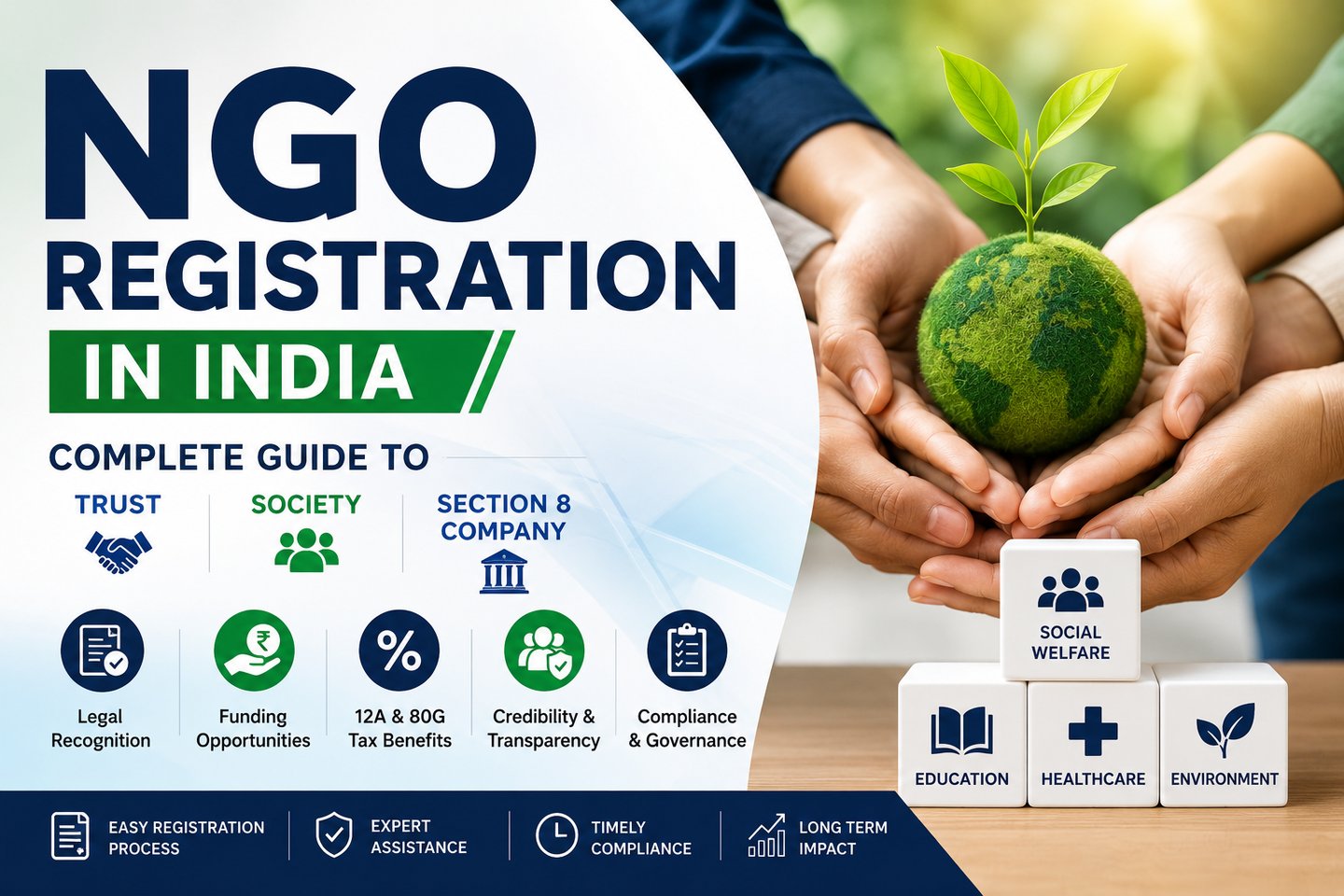
India provides three primary legal structures for NGO registration.
1. Trust Registration
A Trust is established under the Indian Trusts Act and is commonly used for charitable, educational, healthcare, and religious activities.
Key Features
Simple registration process
Suitable for charitable activities
Managed by Trustees
Long-term operational stability
Minimum Requirement
Settlor
Trustees
Trust Deed
Trust registration is widely preferred for charitable institutions, educational foundations, hospitals, and religious organizations.
2. Society Registration
A Society is registered under the Societies Registration Act, 1860.
Societies are commonly formed by groups of individuals working together for charitable, educational, literary, scientific, cultural, or social purposes.
Key Features
Democratic management structure
Governing body and members
Suitable for community-based projects
Transparent administration
Minimum Requirement
Seven members
Society registration is often preferred by educational institutions, cultural associations, research organizations, and welfare groups.
3. Section 8 Company Registration
A Section 8 Company is incorporated under the Companies Act, 2013.
This structure is considered one of the most credible and professionally managed forms of NGO registration.
Key Features
High credibility
Strong governance framework
Separate legal entity
Better opportunities for CSR funding
Greater donor confidence
Suitable For
National-level NGOs
International NGOs
Large charitable organizations
CSR-funded projects
Many corporate donors and funding agencies prefer working with Section 8 Companies due to their transparent governance structure.
Benefits of NGO Registration
Registering an NGO offers several legal and financial advantages.
Legal Recognition
Registration provides official legal status and recognition.
Eligibility for Funding
Registered NGOs can receive:
Government Grants
CSR Funding
International Donations
Private Donations
Institutional Funding
Tax Benefits
Registered NGOs may apply for:
12A Registration
80G Registration
These registrations help reduce tax liabilities and encourage donor contributions.
Enhanced Credibility
Donors, government agencies, and corporate organizations prefer supporting registered NGOs.
Perpetual Existence
The organization continues to exist regardless of changes in management or membership.
Documents Required for NGO Registration
The required documents vary depending on the registration structure.
Common Documents
PAN Card
Aadhaar Card
Passport Size Photographs
Address Proof
Registered Office Proof
Utility Bill
NOC from Property Owner
Additional Documents
For Trust Registration
Trust Deed
For Society Registration
Memorandum of Association (MOA)
Rules & Regulations
For Section 8 Company Registration
MOA
AOA
DSC
DIN
NGO Registration Process in India
Step 1: Select the Appropriate Structure
Choose between:
Trust
Society
Section 8 Company
based on your objectives and future expansion plans.
Step 2: Prepare Foundational Documents
Draft the required legal documents such as Trust Deed, MOA, AOA, and Rules & Regulations.
Step 3: Apply for Registration
Submit the application with supporting documents to the appropriate authority.
Step 4: Verification
The authorities verify the submitted documents.
Step 5: Registration Certificate
Upon approval, the NGO receives its registration certificate.
12A Registration for NGOs
12A Registration provides income tax exemption to NGOs.
Without 12A registration, NGO income may become taxable under applicable tax provisions.
Benefits of 12A Registration
Income tax exemption
Improved financial sustainability
Greater donor confidence
Enhanced credibility
80G Registration for NGOs
80G Registration allows donors to claim tax deductions on donations made to eligible NGOs.
Benefits of 80G Registration
Encourages donations
Attracts corporate donors
Increases fundraising opportunities
Supports long-term growth
Organizations seeking donations should strongly consider obtaining 80G registration.
CSR Funding for NGOs
Corporate Social Responsibility (CSR) funding has become one of the most significant funding sources for NGOs in India.
Companies are increasingly partnering with registered NGOs to implement CSR initiatives in areas such as:
Education
Healthcare
Women Empowerment
Rural Development
Environmental Sustainability
Skill Development
Section 8 Companies are often preferred for large-scale CSR projects due to their governance standards.
NGO Compliance Requirements
Registered NGOs must comply with various legal and regulatory requirements.
Annual Compliance Includes
Income Tax Return Filing
Annual Reports
Financial Statements
Board Meetings
Compliance Records
Audit Requirements
Failure to maintain compliance may result in penalties or cancellation of registrations.
Common Challenges Faced by NGOs
Lack of Proper Registration
Unregistered organizations often struggle to secure funding.
Compliance Issues
Missed filings can create legal complications.
Funding Constraints
Organizations without 12A and 80G registrations may find fundraising more difficult.
Governance Challenges
Proper documentation and transparent administration are essential for long-term sustainability.
NGO Funding Sources
Registered NGOs can receive funding through:
Individual Donations
Corporate CSR Funding
Government Grants
International Funding Agencies
Foundations
Crowdfunding Platforms
Philanthropic Organizations
Diversified funding helps ensure organizational stability.
Why Choose Section 8 Company Registration?
Among all NGO structures, Section 8 Companies offer:
Higher credibility
Better governance
Improved transparency
Strong legal framework
Greater CSR funding opportunities
Professional management structure
For organizations planning significant growth and national-level operations, Section 8 Company Registration is often the preferred choice.
Frequently Asked Questions
Which NGO structure is best?
The choice depends on your objectives, funding requirements, governance preferences, and long-term vision.
Can NGOs earn profits?
NGOs may generate income through activities, but profits cannot be distributed among members.
Is 80G mandatory?
No, but it significantly improves fundraising opportunities.
Can NGOs receive CSR funding?
Yes, eligible registered NGOs may receive CSR funding from companies.
Is NGO registration compulsory?
Registration is strongly recommended to obtain legal recognition, funding eligibility, and tax benefits.
Why Choose Corporating Dreams for NGO Registration?
Corporating Dreams provides comprehensive NGO registration and compliance services, including:
Trust Registration
Society Registration
Section 8 Company Registration
12A Registration
80G Registration
CSR Registration Support
NGO Compliance Management
Annual Filing Assistance
Our experienced professionals guide you through every stage of NGO formation and compliance, helping you focus on creating social impact while we handle the legal requirements.
Conclusion
Starting an NGO is a meaningful step toward creating positive social change. However, selecting the right legal structure, obtaining necessary registrations, and maintaining ongoing compliance are crucial for long-term success.
Whether you choose a Trust, Society, or Section 8 Company, proper registration provides legal recognition, access to funding opportunities, tax benefits, and organizational credibility.
If you are planning to establish an NGO in India, professional guidance can help simplify the registration process and ensure full compliance from the beginning.