
ITR Filing AY 2026-27: Complete Guide to Income Tax Return Filing, Due Dates, Documents, Forms & Tax Saving
ITR Filing AY 2026-27 complete guide covering ITR due dates, ITR-1, ITR-2, ITR-3, ITR-4, tax deductions, income tax return filing process, documents required, penalties, refunds, and tax-saving tips.
INCOME TAX & TDS
Corporating Dreams
6/15/20263 min read
Introduction
Income Tax Return (ITR) filing is one of the most important annual compliance requirements for taxpayers in India. Whether you are a salaried employee, business owner, freelancer, professional, investor, pensioner, or NRI, filing your Income Tax Return correctly and within the prescribed deadline helps maintain tax compliance and avoids penalties.
For Assessment Year (AY) 2026-27 (Financial Year 2025-26), the Income Tax Department has introduced certain changes in filing timelines and reporting requirements. Taxpayers should understand the correct ITR form, applicable due date, required documents, deductions available, and the consequences of delayed filing.
This comprehensive guide covers everything you need to know about ITR Filing AY 2026-27.
What is an Income Tax Return (ITR)?
An Income Tax Return (ITR) is a form through which taxpayers report their income, deductions, tax payments, exemptions, and other financial information to the Income Tax Department.
ITR filing enables taxpayers to:
Report annual income
Claim tax refunds
Carry forward losses
Maintain financial records
Comply with Income Tax laws
Avoid penalties and notices
Financial Year vs Assessment Year
Many taxpayers confuse Financial Year (FY) and Assessment Year (AY).
Financial Year (FY 2025-26)
Income earned between:
1 April 2025 to 31 March 2026
Assessment Year (AY 2026-27)
Period during which income earned during FY 2025-26 is assessed and taxed.
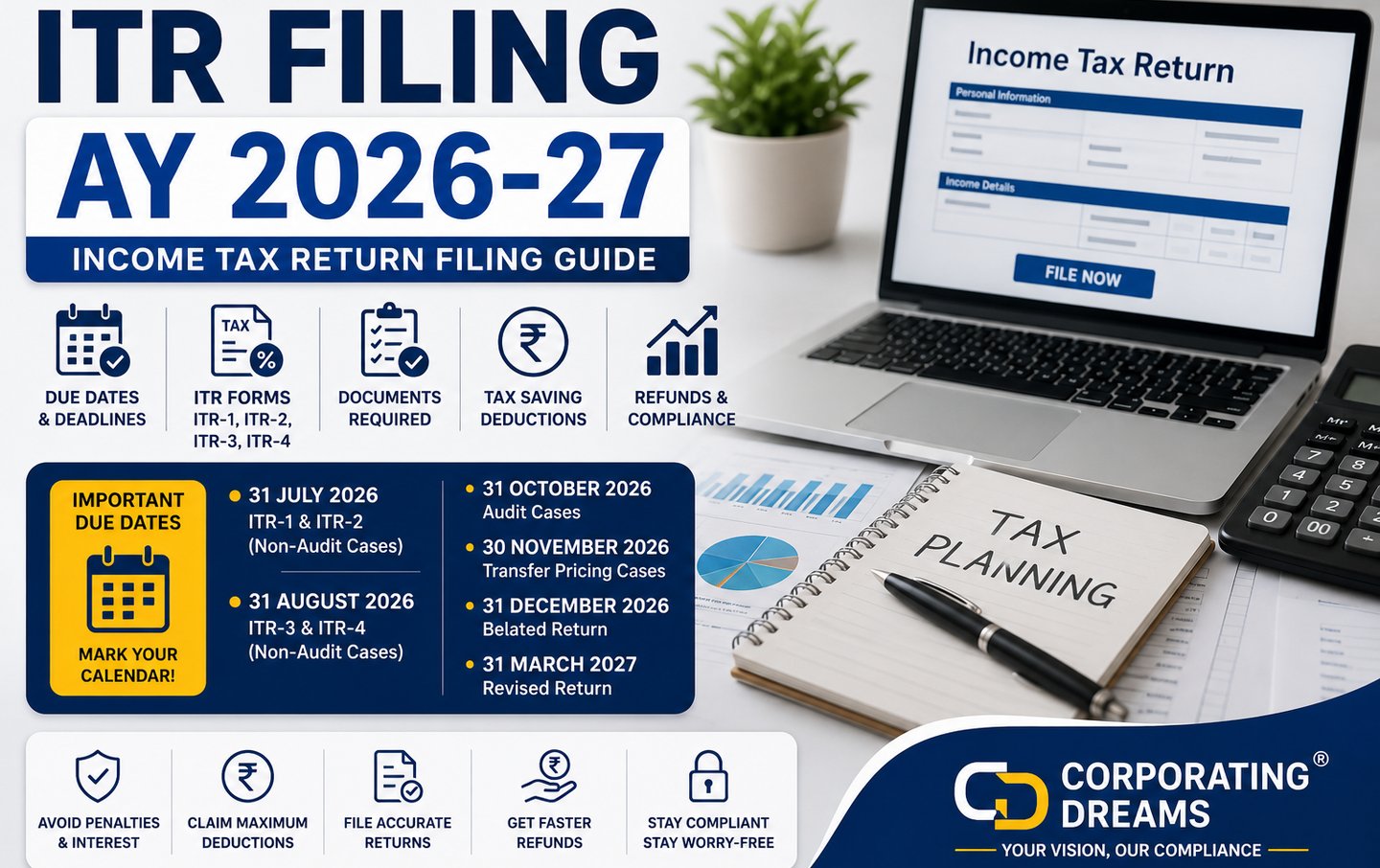
ITR Filing Due Dates for AY 2026-27
The due date depends on the category of taxpayer and applicable ITR form.
ITR-1 & ITR-2 (Individuals, Non-Audit Cases)-31 July 2026
ITR-3 & ITR-4 (Non-Audit Business/Profession Cases)-31 August 2026
Tax Audit Cases-31 October 2026
Transfer Pricing Cases-30 November 2026
Belated Return-31 December 2026
Revised Return-31 March 2027
The Finance Act 2026 introduced a separate due date of 31 August 2026 for many non-audit business and professional taxpayers filing ITR-3 or ITR-4.
ITR-2
Applicable for individuals and HUFs having:
Capital Gains
Foreign Assets
Foreign Income
Multiple House Properties
Income above ₹50 lakh
Directorship in a company
ITR-3
Applicable for:
Business Income
Professional Income
Proprietorship Businesses
Trading Income
Futures & Options Income
ITR-4 (Sugam)
Applicable under presumptive taxation schemes:
Section 44AD
Section 44ADA
Section 44AE
for eligible taxpayers with income up to prescribed limits.
Documents Required for ITR Filing AY 2026-27
Before filing, keep the following documents ready:
Personal Documents
PAN Card
Aadhaar Card
Bank Account Details
Salary Income
Form 16
Salary Slips
Tax Records
Form 26AS
AIS (Annual Information Statement)
TIS (Taxpayer Information Summary)
Investment Proofs
LIC Premium Receipts
PPF Contributions
ELSS Investments
Tax Saving FD Receipts
Other Documents
Home Loan Interest Certificate
Capital Gain Statements
Mutual Fund Statements
Rent Receipts
Interest Certificates from Banks
These records help ensure accurate reporting and deduction claims.
Important Deductions Available
Taxpayers can reduce taxable income through eligible deductions.
Section 80C
Maximum deduction up to ₹1.5 lakh through:
PPF
ELSS
Life Insurance
EPF
NSC
Tax Saving FD
Section 80D
Health Insurance Premium deduction.
Section 80G
Eligible charitable donations.
Section 24(b)
Home Loan Interest deduction.
NPS Deduction
Additional deduction under Section 80CCD(1B).
Common Mistakes to Avoid While Filing ITR
Many taxpayers receive notices because of avoidable errors.
Selecting the Wrong ITR Form
Using an incorrect form may invalidate the return.
Ignoring AIS and Form 26AS
Always reconcile income details before filing.
Missing Interest Income
Savings account and FD interest must be disclosed.
Incorrect Bank Details
Wrong bank information may delay refunds.
Not Reporting Capital Gains
Stock market and mutual fund transactions should be reported accurately.
New Reporting Requirements for AY 2026-27
Taxpayers should carefully review updated disclosures relating to:
Capital Gains
Buyback Transactions
Certain Trading Activities
The Income Tax Department has expanded reporting requirements in some return forms.
Penalty for Late ITR Filing
If you fail to file within the prescribed due date:
Late Filing Fee
Under Section 234F:
₹1,000 for specified lower-income cases
Up to ₹5,000 in other eligible cases
Interest
Interest may be charged on unpaid tax liability under applicable provisions.
What is a Belated Return?
If you miss the original due date, you may still file a Belated Return.
Last Date for Belated Return
31 December 2026
However, penalties and interest may apply.
What is a Revised Return?
A Revised Return allows taxpayers to correct errors in a previously filed return.
Last Date for Revised Return
31 March 2027
Examples:
Wrong bank details
Missing income
Incorrect deductions
Data entry mistakes
Tax Refund Process
If excess tax has been deducted or paid:
File the Income Tax Return.
Verify the return.
Return is processed by the department.
Refund is credited directly to the validated bank account.
Why File ITR Even If Income is Below Taxable Limit?
Filing ITR provides multiple benefits:
Easier Loan Approval
Visa Processing
Financial Record Maintenance
Carry Forward of Capital Losses
Faster Refund Claims
Better Financial Credibility
Useful Tax Tools
You can also use:
Income Tax Calculator
HRA Calculator
Old vs New Tax Regime Calculator
Capital Gain Calculator
Gratuity Calculator
NPS Calculator
SIP Calculator
EMI Calculator
Why Choose Corporating Dreams for ITR Filing?
Our Income Tax experts assist with:
ITR-1 Filing
ITR-2 Filing
ITR-3 Filing
ITR-4 Filing
Capital Gain Reporting
Tax Planning
Notice Handling
Revised Returns
Business Tax Compliance
We ensure accurate filing, timely submission, and maximum eligible tax benefits.
Conclusion
Income Tax Return filing is not merely a legal requirement—it is an important financial responsibility that helps maintain compliance, establish financial credibility, and claim eligible refunds and deductions.
For AY 2026-27, taxpayers should carefully choose the correct ITR form, reconcile AIS and Form 26AS data, claim eligible deductions, and file within the applicable due date to avoid penalties and notices.
Whether you are a salaried employee, freelancer, investor, startup founder, or business owner, timely and accurate ITR filing can save both money and future compliance issues.